1. The 6-Step Habit for Reading Any Result
Numbers in TangoPosture are never a dance grade. They are simple observations from a 2D camera image designed to answer specific questions like "Did my chin drop during that giro?" or "Did we begin walking together on the phrase?"
Remember: a missing value is never zero. When a shoulder or foot is hidden behind your partner, TangoPosture refuses to invent a number—so even when a smooth skeleton line is drawn, check coverage before drawing conclusions.
2. Units & Status Labels in Plain English
| Term | What It Means for a Dancer | Quick Example |
|---|---|---|
Degrees (°, deg) |
Tilt or bend angle. 0° is the reference vertical or horizontal line. |
8° torso tilt is a gentle lean; 0° is upright plumb. |
Milliseconds (ms) |
Thousandths of a second (timing differences between partners or beats). | +150 ms = 0.15 seconds later (about 4–5 frames at 30 FPS). |
| Torso lengths | Distance scaled to your own torso height on screen (so stepping closer or farther stays comparable). | +0.10 head forward = 10% of your torso length, not 10 cm. |
| Coverage (%) | Percentage of frames where the camera clearly saw the required body points. | 85% usable coverage means 15% of frames had hidden/uncertain joints. |
| Median & IQR | Your typical middle value (Median) and how consistent you stayed across the middle half of steps (IQR). | Smaller IQR means more consistent repetition—not automatically "better". |
| Measured / Estimated / Confirmed | Measured = clear landmarks. Estimated = detector suggestion (replay to verify). User confirmed = you verified it. | Always double-check estimated foot contacts in Review before judging timing. |
3. What Every Solo Overlay Means on Screen
When you open Self Practice or Review, TangoPosture draws body geometry lines right over your practice video so you can read alignment at a glance:
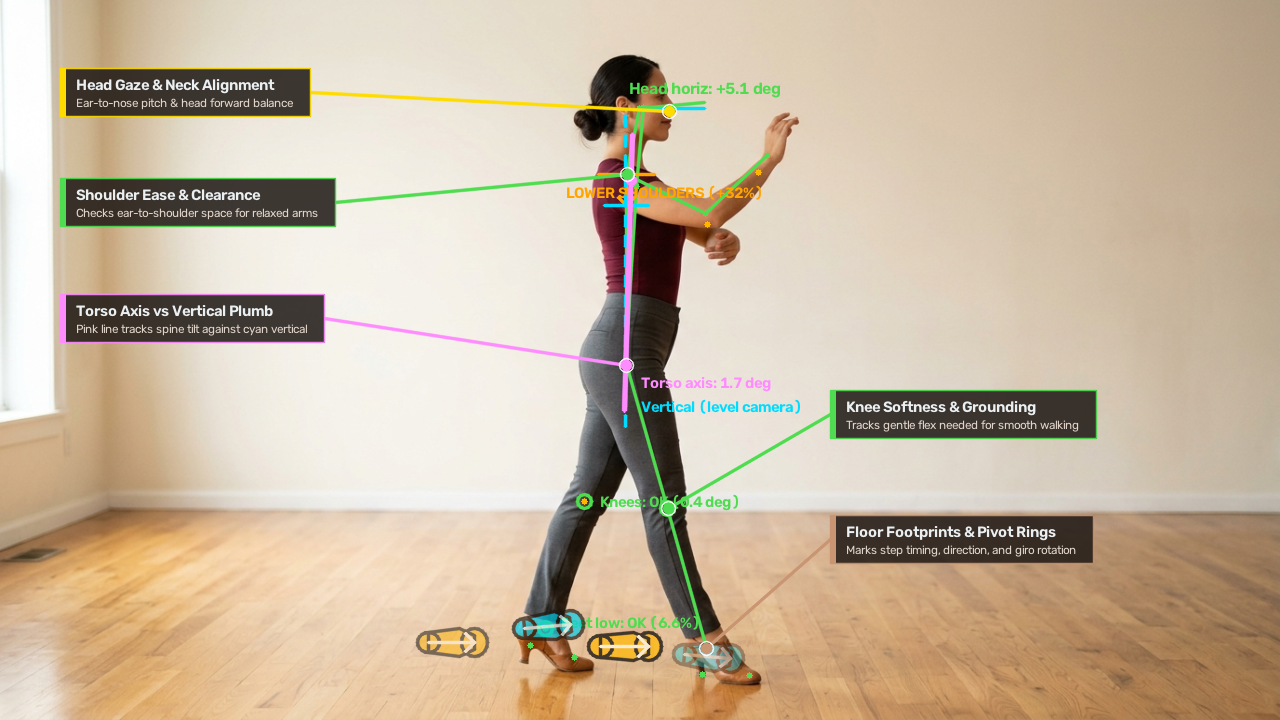
- Green vs. Orange dots: Green joints passed strict clarity gates; orange joints have lower visibility (for instance, a far-side knee behind your standing leg).
- Solid, dashed, and dotted bones: Solid = directly detected; dashed = backward-pass refined; dotted = bridged over a brief visual gap (display-only, never counted as real measurement).
- Pink torso line vs. Cyan vertical line: Shows your shoulder-to-hip line next to a true level-camera plumb line.
- Floor footprints & pivot ring: Left/right heel-to-toe markers fade smoothly over the last few seconds of walking, while a perspective ellipse highlights detected pivots and their clockwise/anticlockwise direction.
4. Your 12 Solo Posture Metrics (Grouped by Body Feeling)
Eight of these metrics can be approved as personal bounds inside a .tpc calibration
profile, and four act as smoothed live coaching traces. An approved range is simply your
chosen comfort zone for that camera angle.
Head & Gaze — Keeping Your Horizon Open
head_pitch)CalibrationRaw angle of your ear-to-nose line compared to horizontal. Negative values (like -12°) mean your chin/nose points slightly downward.
head_angle)Live TraceYour head_pitch minus your natural neutral offset—so 0° means your relaxed head carriage, and drops show looking down at your feet.
head_forward)CalibrationHow far forward your ear sits in front of your shoulder (in torso lengths). Useful for spotting neck "reaching" forward into the embrace.
head_inclination)CalibrationAngle of your shoulder-to-ear neck line relative to your trunk—shows whether your head stays stacked smoothly with your spine.
Shoulders & Embrace Ease — Letting Arms Breathe
shoulder_clearance)CalibrationVertical space between your ear and shoulder scaled to your body size. Smaller values mean your shoulders crept up toward your ears.
shoulder_elev_pct)Live TracePercentage reduction compared to your neutral relaxed clearance (e.g., +20% means shoulders lifted noticeably—prompting a gentle exhale and release).
Torso Axis & Hips — Traveling on One Piece
torso_axis_tilt)CalibrationMagnitude of tilt (always positive, e.g., 4°) of your hip-midpoint to shoulder-midpoint line from vertical. Checks upright poise without judging leaning right vs. left.
trunk_inclination)CalibrationSigned lean relative to your facing direction—positive means projecting forward toward your direction of travel (apilado / forward intention).
hip_offset)CalibrationHow far your hips sit behind or ahead of the straight line between ankle and head—spotting "sitting back" out of your axis.
axis_curve_smoothed)Live TraceSmoothed percentage version of hip offset over time (not a medical spinal curvature measure).
Knees & Grounding — Elastic Walk, Quiet Upper Body
knee_flexion)CalibrationBend angle of your straightest reliable knee (180° − interior angle). Around 8°–20° gives a grounded, elastic tango walk without locked knees.
knee_bend_deg)Live TraceSmoothed knee bend trace over time, catching moments where legs stiffen straight during a closed-embrace walk.
<= 115 BPM) when ankles lift unusually high across consecutive walking steps. Treat these as light practice cues—changing camera angle can change arm/ankle estimates.
5. Why Alerts Don't Flicker on Single Steps
A split-second look down or a single momentary knee straighten shouldn't flash a red warning. TangoPosture uses two safeguards before marking a frame out of range:
- Temporal Smoothing: Rapid frame-to-frame noise is softly averaged without blending across tracking gaps larger than
max_gap(default0.5 s). - Entry & Clear Patience (Hysteresis): A posture shift stays Pending (amber) until it lasts past
entry_duration(e.g.,1.5 s), and clears once you return inside your comfort zone forclear_duration(0.75 s).
6. Couple Overlays & Confirming Partner Identities
In Couple mode, TangoPosture tracks both partners from one camera and projects their axes and shared relationship onto the frame:
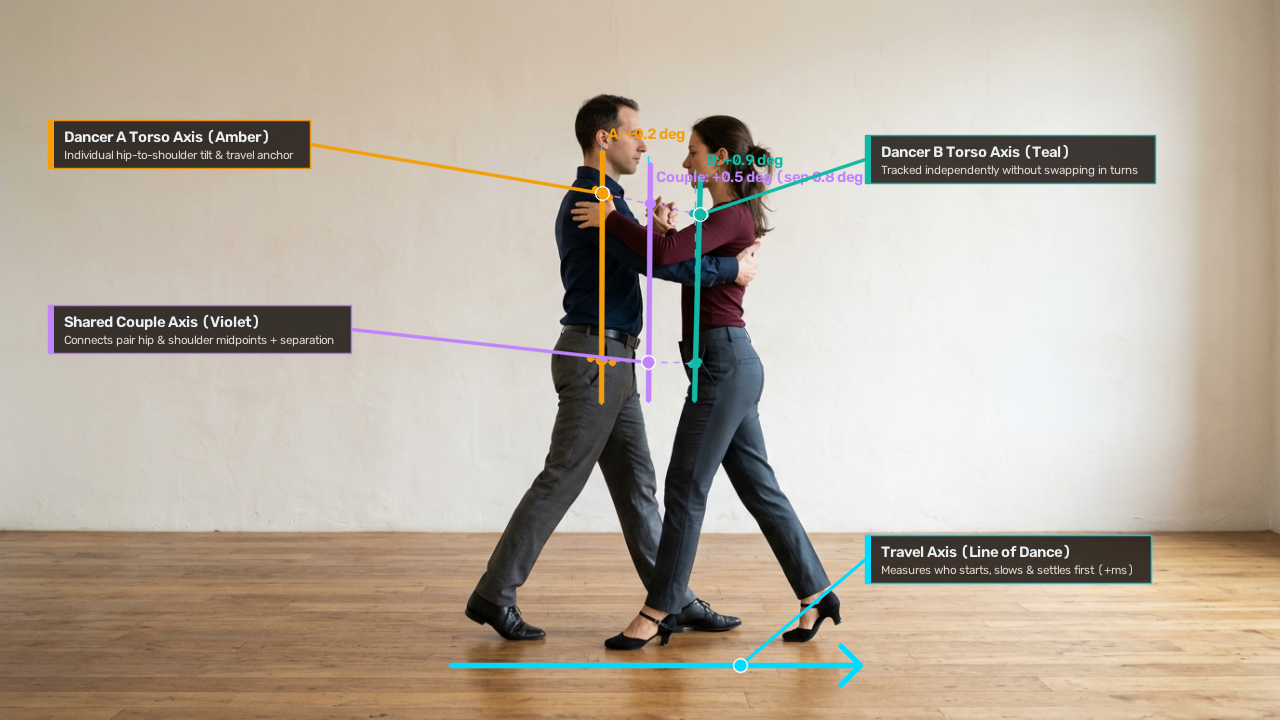
A and B are camera tracking identities—not automatic proof of Leader vs. Follower. In Video Analysis, mark Dancer A and Dancer B on the opening frame and check in Review that neither label swapped during a turn or camera overlap.
7. Understanding Couple Timing, Connection & Turns
Couple outputs are grouped into five clear dance questions. There is no artificial single "connection percentage"—each domain tells its own story:
1. Walking Together — Travel & Coordination
Measures hip travel projected along your line of dance (velocity_a, velocity_b, velocity_pair) and compares who initiates, slows, and settles first:
start_lag_ms/slow_lag_ms/settle_lag_ms: Median time of Dancer B minus Dancer A. For example,+120 mson starts means B starts 0.12 s after A;-100 mson slows means B slows slightly earlier.- Check
paired_countvs.unpaired_countso you know how many shared phrases were matched.
2. Dancing on the Music — Step & Beat Timing
Matches apparent foot contacts against estimated or manually tapped musical beats:
beat_offset_ms&beat_fraction: Contact time minus nearest beat target.+100 mson a500 msbeat (120 BPM) is+0.20of a beat behind—helpful for exploring dancing slightly ahead, squarely on, or lazily behind the beat!- Always confirm the musical beat grid in Review when checking off-beat or half-beat (
traspie) steps.
3. Smooth Pauses & Direction Changes — Transitions
Inspects moments where the couple slows down to pause or reverse direction:
secondary_speed_peaks&unintended_reversals: Counts sustained speed bumps or direction reversals during a pause window—unless you already marked them as a planned pause, planned reversal, or settling step.
4. Shared Axis & Embrace Alignment — Couple Posture
Compares both partners' screen-based hip-to-shoulder lines side by side:
torso_tilt_a&torso_tilt_b: Individual tilt relative to screen vertical (positive = leaning right, negative = leaning left).couple_midpoint_tilt&torso_separation: Tilt of the pair's shared midpoint axis and angular difference between A and B (e.g.,+8°and-6°=14°separation in an open V-frame or apilado).torso_tilt_pearson_r: Measures whether A and B's tilts rise and fall in sync (from-1to+1), regardless of a constant lean angle difference.
5. Giros, Ochos & Clean Exits — Turns
Summarizes turn duration and how cleanly the exit flows out of the rotation:
turn_duration_s&exit_minus_turn_end_ms: How long each turn lasted and whether the exit began slightly after turn completion (+200 ms) or overlapped early (-100 ms, counted inoverlap_count).- Record your own human notes right on each turn:
pivot_behavior_a/bandembrace_opening.
8. Real Dance Habit vs. Camera Tracking Glitch?
- Usable coverage is high (
>= 85%) and joints are green in Review. - You see the exact same pattern across 3+ phrases or multiple songs.
- You can visibly confirm the movement when stepping
-1 / +1frame on the raw video.
- Coverage drops suddenly or joints turn orange/dotted during an arm wrap or turn.
- Values jump only when walking straight toward the lens or near the extreme frame edge.
- A mirror reflection or bystander entered the frame in Review.
9. Five Focused 15-Second Drills to Try Tonight
- Neutral Salon Axis Check (Solo): Stand quietly for 5 seconds, then walk 4 slow steps toward the camera side-on. Check that your pink torso axis stays steady inside your
.tpcgreen band without bobbing. - Horizon Gaze Walk (Solo): Walk a full musical phrase keeping your chin off your chest—aim for zero red
head_angledrops across the phrase. - Soft-Knee Collection (Solo): Pause on your standing leg between steps and inspect
knee_flexionin Review to make sure you don't lock the knee before projecting. - Start & Settle Sync (Couple): Walk 4 slow steps, pause for 4 beats, walk 4 more. Inspect
start_lag_msandsettle_lag_msto see how smoothly your partner receives the invitation and the pause. - Clean Giro Exit (Couple): Film a single giro with a calm exit into the walk. Check
exit_minus_turn_end_msandsecondary_speed_peaksto verify you finish collecting before launching the next step.